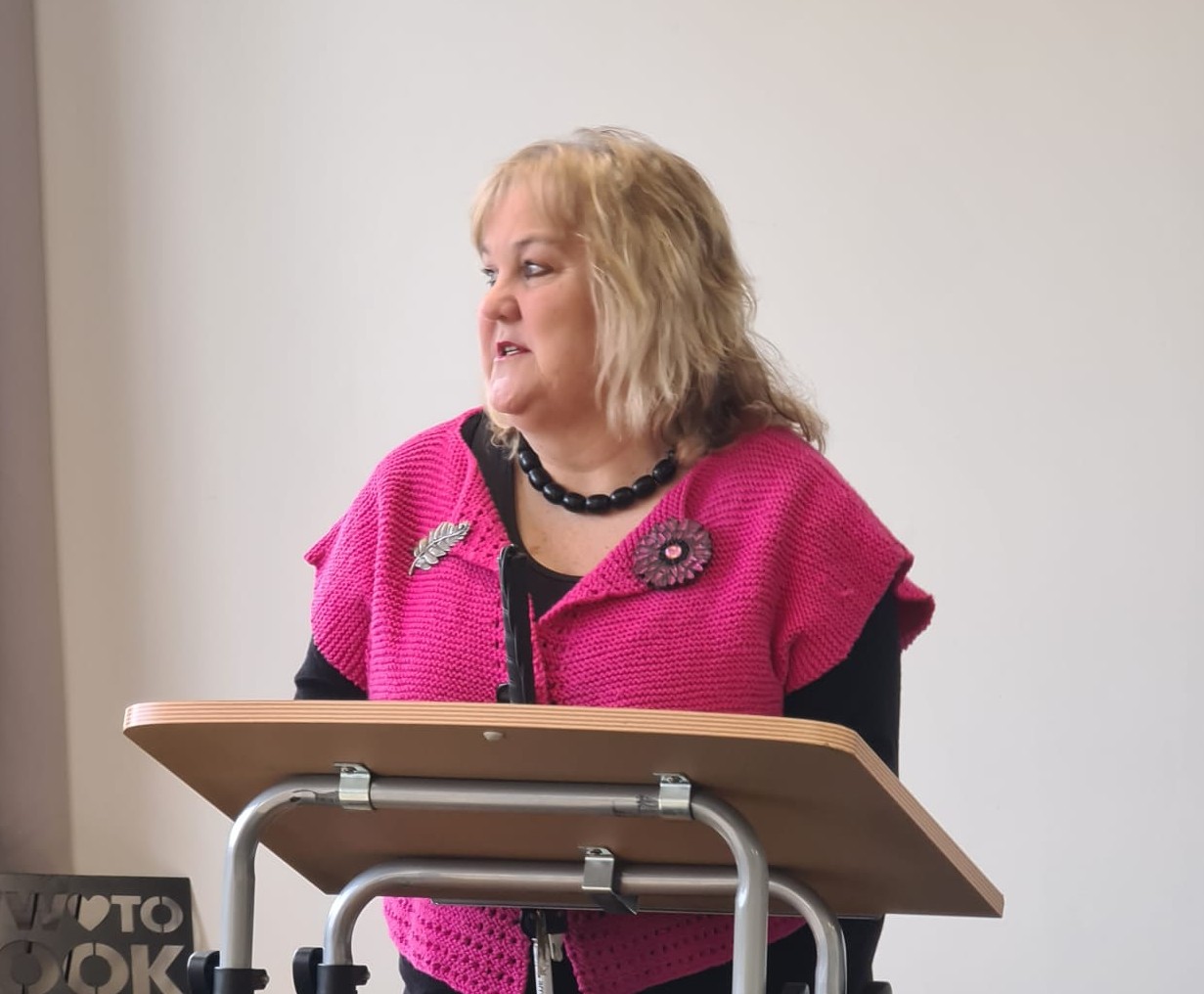
Photo taken by Tony Guy
Last Thursday's Rotary lunch featured a talk from Dunedin-based motivational speaker Julie Woods, widely known by her brand "That Blind Woman."
Julie shared how she lost her sight, with partial blindness starting at the age of 18 as a university student working on her BCom at Otago. In her early 30s, after noticing the vinyl on her bathroom floor appeared to shimmer, she was referred to Dunedin Hospital, where she was declared legally blind in March 1997, at a time when she had two very young sons at home. Rather than accept sympathy, she chose to reframe blindness as a beginning rather than an ending and adopted the mantra "Why Not?" as the guiding philosophy for the rest of her life.
She spoke about the origins of her One Million Names in Braille project, which grew out of a simple idea in 2012 to print the Braille alphabet on the back of her business cards. That small gesture developed into a global initiative launched in 2017, through which she and her husband Ron have now transcribed over 44,000 of names by hand, aiming eventually to reach one million as a way of raising awareness of Braille and connecting people around the world "one dot at a time." Remarkably, Julie recounted many names of individuals and groups she has written names in braille from all around the world. She asked members to write their names and those of family and friends, so she can write these names in braille and send the cards to these people.
On travel, Julie described her ambition to visit all Seven Wonders of the World, a goal she achieved by 2014 alongside Ron, along with reaching 50 countries before turning 50, and has more recently completed 60 countries by age 60. She highlighted in some of the places she has travelled to and the senses that she experiences like smell, taste, sound and touch recorded in her daily diary, through to walking every street in Dunedin finishing the project by walking Every Street.
Finally, Julie spoke about her current work supporting entrepreneurship among people with disabilities. Alongside co-founders, she runs the Disability Business Network and its My Business Starter Programme, delivered in partnership with CCS Disability Action. The nine-week programme, run over Zoom, helps disabled people test and develop business ideas through group and small-group coaching sessions, culminating in a short business plan and a decision to either pursue or shelve the idea.
Overall, Julie's talk combined humour, personal resilience, and a strong practical message about accessibility and inclusion in business and everyday life.